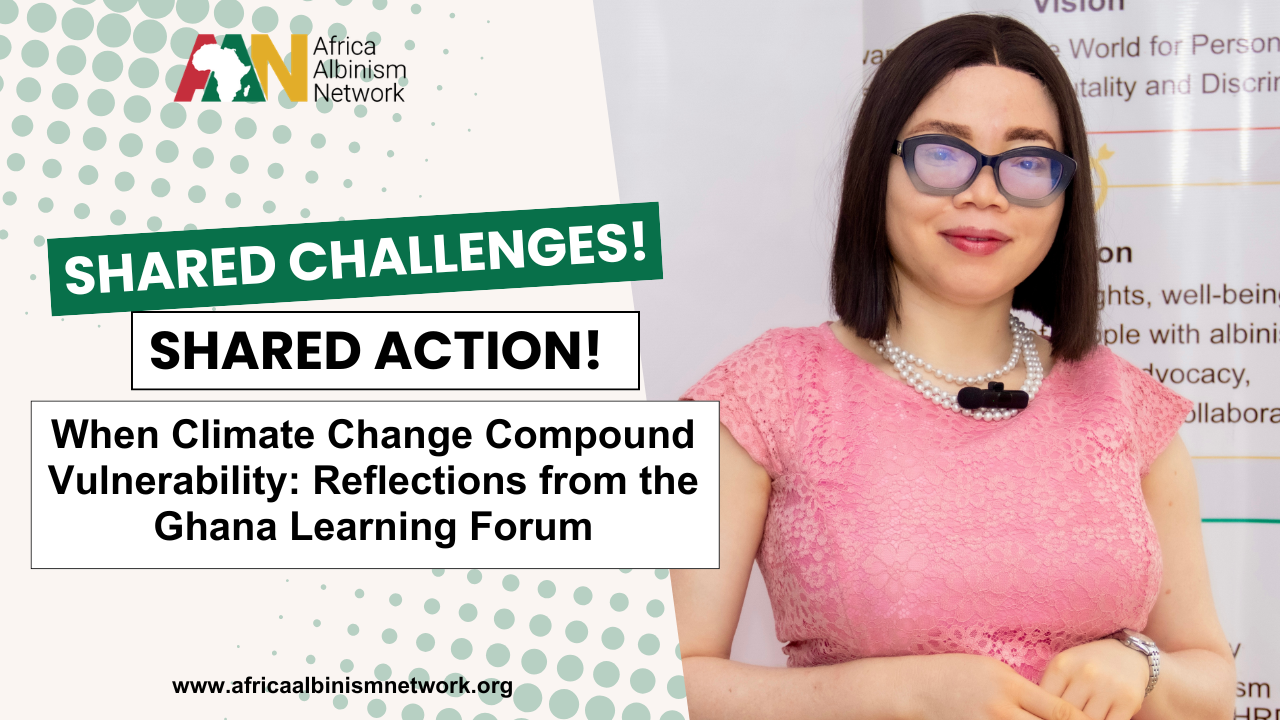
Watch as Hilda Macheso briefly shares her experience at the Africa Climate Summit, reflects on key takeaways, and delivers an inspiring message to African youth with albinism.
The intersection of health, climate change, and disability rights is often discussed in abstract policy terms. But for persons with albinism in Africa, these issues are personal, urgent, and a matter of survival.
In September, two significant developments marked important progress for disability and climate advocates:
- The World Health Organization (WHO) recognized broad-spectrum sunscreen as an essential medicine, and
- African leaders gathered in Addis Ababa, Ethiopia for the Africa Climate Summit (ACS).
To understand what these milestones mean on the ground, we spoke with Hilda Macheso, a passionate advocate for persons with albinism from Malawi and Bonface Massah, Executive Director of the Africa Albinism Network, who gave a powerful closing speech at the ACS during a side event hosted by the African Disability Forum titled, “Accelerating Global Climate Solutions: Financing for Africa’s Resilient and Green Development“.
The side event underscored the urgent need for financial intervention, with the emphasis that climate change is not gender- or disability-neutral. As climate disasters intensify across Africa, persons with disabilities bear the brunt of exclusion, loss, and harm, yet only a tiny fraction of Official Development Assistance (ODA) have been targeted at this triple intersection of climate, gender, and disability.
Sunscreen: A Right, Not a Privilege
For years, the albinism community has adocated for a shift in perception of sunscreen from a cosmetic “want” to a medical “need”. The WHO’s decision to list it as an essential medicine is a landmark victory.
“I was so excited as an advocate,” Hilda shares. “The fact that accessibility of sunscreen is a right and not a privilege… it’s an absolute win. Knowing skin cancer cases in Africa, this is going to curb that. It’s a full-circle moment.”
However, recognition is only the first step. Hilda emphasizes that the real barrier in African communities is the cost, often driven by weak local currencies struggling against the foreign exchange needed to import these products.
“We have to establish local bases,” Hilda argues, suggesting a move toward local production plants to bypass foreign currency shortages. “People’s lives are already at stake. We can’t wait for foreign currency… It has to be handled like medicine.”
The Climate Connection: “The Poorest at the Bottom of the Barrel”
Why link sunscreen to climate change? Because as the planet warms, the risk to persons with albinism intensifies. Beyond the physical sun exposure, climate policies, such as the “Just Transition”, often threaten to leave persons with disabilities behind.
Hilda points out that banning traditional fuel sources like charcoal without affordable alternatives disproportionately hurts persons with disabilities, who often face a significant poverty gap.
“For a just transition to happen… we have to make it a point not to leave anyone behind,” Hilda explains. “Persons with disabilities tend to be at the bottom of the barrel when it comes to poverty. If you take away the basic things they use, what are they going to use? The mechanisms for transition must be inclusive.”
Financing Resilience: From Policy to Action
At ACS, Bonface delivered the closing speech at the African Disability Forum’s side event on “Accelerating Global Climate Solutions: Financing for Africa’s Resilient and Green Development.”
Bonface called for increased financial flow toward sustainable disability-inclusive and environmentally friendly health programs that are accessible to persons with disabilities. There is an urgent need to invest and fund skin cancer prevention programs that will bring change in quality of life for persons with albinism, including incentives for health workers to deliver the programs.
The Africa Climate Summit: Holding the Global North Accountable
The Africa Climate Summit was convened to position Africa not as a victim, but as a leader in green growth. However, for advocates like Hilda, the summit was also about holding the Global North accountable.
“The African Climate Summit was about finding solutions to this existential crisis that is really being perpetuated by the Global North,” Hilda notes, highlighting that Africa contributes less than 4% of global emissions yet bears the brunt of the impact.”
She offers a critique of Carbon Credits, a major talking point at the summit.
“To me personally, they just sound wrong… It’s like they are buying rights to destroy the environment, and we must clean up their messes. It feels like ‘hush money.”
Furthermore, she highlighted the cycle of debt that affects African nations, preventing them from investing in their own sovereign solutions.
Focus: From Policy to Action
The summit resulted in the Addis Ababa Declaration, full of commitments and promises. But as the African Disability Forum and partners discussed, implementation is key.
Building from the Global Disability Summit commitments and the Nairobi Declaration call for immediate financing of organizations of persons with disabilities as rights holders to be at the center of climate solution. Time is now to go beyond traditional funding or policy reform on disability programs but focus on long term investment decision to reduce the impact of climate change and increase opportunities for participation of persons with disabilities in climate action.
The Future is Representative
Looking ahead to future global forums like COP, Hilda’s message is clear: General representation isn’t enough. We need specific voices for specific experiences. A person with a physical disability cannot necessarily speak for the experience of a person with albinism. One policy cannot fit all.
“We have hidden costs associated with excluding people”, Hilda warns. But she finds hope in the youth of Africa, a demographic making up nearly 70% of the continent. “The youth can amplify what they are experiencing. That forms a basis for change”.
A Call to Action
The WHO decision on sunscreen is a victory. The Africa Climate Summit was a platform. But the real work lies in ensuring that when we talk about “Green Development”, we are building a world where protection from the sun and economic survival are for everyone.
We are deeply grateful to Global Greengrants Fund for their invaluable support in making these advocacy milestones possible.